
What Is Mixed Voice, Really?

Voice Training

The physiology behind the term — and why so many singers get confused.

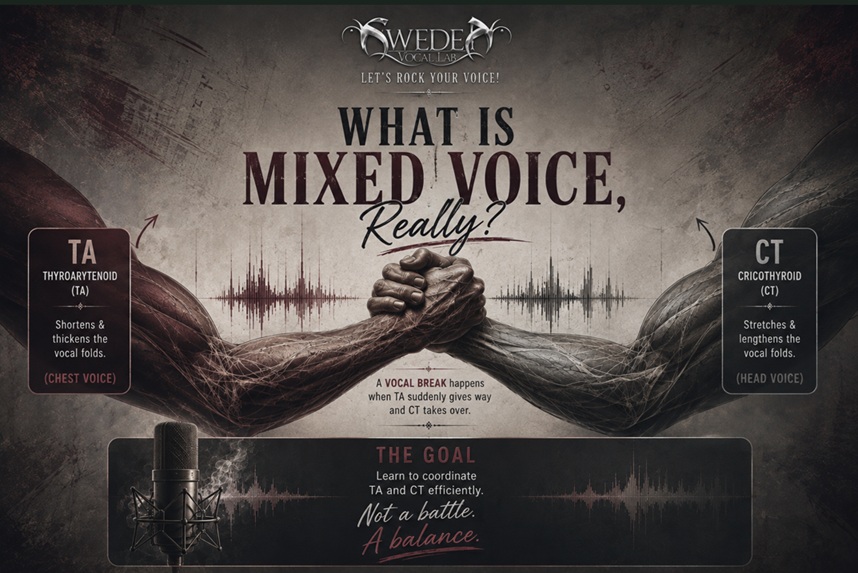
Illustration explaining the coordination between TA and CT in mixed voice

Mixed Voice Is Probably One of the Most Misunderstood Terms in Vocal Training

Depending on who you ask, it can mean completely different things.

To understand what it really is, it helps to start with a very simplified view of how the voice works.

What Really Creates the Perception of Chest and Head Voice

Inside your larynx are two main groups of muscles that work against each other: the thyroarytenoid (TA) muscles and the cricothyroid (CT) muscles.

The TA muscles are responsible for shortening and thickening the vocal folds and are generally associated with what singers perceive as chest voice.

The CT muscles do the opposite: they stretch and lengthen the vocal folds and are generally associated with head voice.

Imagine your two arms in an arm wrestle. Sometimes one arm gains the upper hand, sometimes the other, but neither ever completely lets go.

In a typical speaking voice, the TA muscles usually do most of the work, while the CT muscles contribute relatively little. In falsetto, the opposite is true: the CT muscles dominate while the TA contribution becomes minimal.

What Creates the Vocal Break

When these muscles haven't yet learned to coordinate efficiently, the TA tends to hold on for as long as possible. Eventually it can no longer resist, suddenly gives way, and the CT takes over. This is what creates the familiar vocal "break" or "flip" from a pure chest voice into a pure head voice or falsetto.

Learning to coordinate these two muscle groups is one of the foundations of good and healthy vocal technique, and it is something that should be developed from the very beginning of vocal training.

What Singers Usually Mean by Mixed Voice

Now, this coordination is the foundation of healthy singing in virtually every musical style, from classical to pop, rock and musical theatre.

When singers and teachers talk about mixed voice, however, they usually mean something more specific.

The term generally refers to this muscular coordination combined with a vocal quality that is characteristic of many contemporary singing styles.

Compared to a more traditional head voice, this quality typically sounds:

  • brighter and more speech-like;
  • stronger and more direct;
  • less "classical" in its overall tone.

Mixed Voice Is Not Chest Voice Pushed Higher

For this reason, you'll sometimes hear mixed voice described as "bringing chest voice higher."

This is not an anatomically accurate description of what is happening.

The problem is that, when taken literally, this idea can easily lead singers to force or "drag" chest voice higher and higher in an attempt to create a mixed voice. This is one of the most common technical mistakes in vocal training and can result in unnecessary tension, reduced vocal efficiency, and, over time, even vocal fatigue.

A healthy mixed voice is not created by pushing chest voice upward. It is the result of a well-coordinated balance between the TA and CT muscles, combined with the vocal tract adjustments that give the voice its characteristic contemporary sound.

There Isn’t Just One Type of Mix

There isn't just one type of mix. It can have a greater contribution from either the TA or the CT muscles while still remaining a balanced coordination. In other words, it can sound more chesty or more heady.

The balance between the TA and CT muscles is the foundation of a healthy mixed voice, but it isn't the only factor that influences how it sounds. Other aspects of voice production also contribute to its final character. The good news is that, once you've built a solid coordination, exploring those possibilities becomes the enjoyable part. You're no longer trying to "find" your mixed voice, but simply discovering the sound you like best.

Once you learn how to coordinate the balance between the TA and CT muscles, you can gradually shape your own mix according to the sound you prefer and the musical style you want to sing.

The purpose of this article is to explain a key concept in a way that is useful for singers. It isn't intended to be a comprehensive explanation of how the voice works or to cover every anatomical detail.

Svenska

Vad är egentligen mixed voice?

Fysiologin bakom begreppet — och varför så många sångare blir förvirrade.

Mixröst är förmodligen ett av de mest missförstådda begreppen inom sångteknik

Beroende på vem du frågar kan det betyda helt olika saker.

För att förstå vad det egentligen är, hjälper det att börja med en mycket förenklad bild av hur rösten fungerar.

Vad skapar egentligen upplevelsen av bröst- och huvudröst?

Inuti struphuvudet finns två huvudsakliga muskelgrupper som arbetar mot varandra: thyroarytenoidmusklerna (TA) och cricothyroidmusklerna (CT).

TA-musklerna ansvarar för att förkorta och förtjocka stämbanden och förknippas i allmänhet med det som sångare uppfattar som bröströst.

CT-musklerna gör motsatsen: de sträcker och förlänger stämbanden och förknippas i allmänhet med huvudröst.

Föreställ dig att dina två armar möts i en armbrytning. Ibland får den ena armen övertaget, ibland den andra, men ingen av dem släpper någonsin helt taget.

I en vanlig talröst gör TA-musklerna vanligtvis det mesta av arbetet, medan CT-musklerna bidrar relativt lite. I falsett är det tvärtom: CT-musklerna dominerar medan TA-musklernas bidrag blir minimalt.

Vad orsakar röstsprånget?

När dessa muskler ännu inte har lärt sig att samordna sig effektivt försöker TA-musklerna hålla kvar kontrollen så länge som möjligt. Till slut orkar de inte längre, ger plötsligt efter och CT-musklerna tar över. Det är detta som skapar det välkända röstsprånget eller "flippen" från en ren bröströst till en ren huvudröst eller falsett.

Att lära sig samordna dessa två muskelgrupper är en av grunderna för en god och hälsosam sångteknik, och något som bör utvecklas redan från början av röstträningen.

Vad sångare vanligtvis menar med mixröst

Denna samordning är grunden för hälsosam sång i praktiskt taget alla musikstilar, från klassiskt till pop, rock och musikal.

När sångare och sångpedagoger talar om mixröst menar de dock vanligtvis något mer specifikt.

Begreppet syftar i allmänhet på denna muskulära samordning i kombination med en röstkvalitet som är typisk för många moderna sångstilar.

Jämfört med en mer traditionell huvudröst låter denna röstkvalitet vanligtvis:

  • ljusare och mer tallik;
  • starkare och mer direkt;
  • mindre "klassisk" i sin övergripande klang.

Mixröst är inte bröströst som pressas högre upp

Därför hör man ibland mixröst beskrivas som att "ta upp bröströsten högre".

Det är inte en anatomiskt korrekt beskrivning av vad som faktiskt händer.

Problemet är att denna idé, om den tolkas bokstavligt, lätt kan få sångare att pressa eller "dra" upp bröströsten allt högre i ett försök att skapa en mixröst. Det är ett av de vanligaste tekniska misstagen inom sångträning och kan leda till onödig spänning, sämre rösteffektivitet och, med tiden, även rösttrötthet.

En hälsosam mixröst skapas inte genom att pressa bröströsten uppåt. Den är resultatet av en välkoordinerad balans mellan TA- och CT-musklerna, i kombination med de justeringar i ansatsröret som ger rösten dess karakteristiska moderna klang.

Det finns inte bara en typ av mix

Det finns inte bara en typ av mix. Den kan ha ett större bidrag från antingen TA- eller CT-musklerna och ändå vara en balanserad samordning. Med andra ord kan den låta mer bröstdominerad eller mer huvuddominerad.

Balansen mellan TA- och CT-musklerna är grunden för en hälsosam mixröst, men det är inte den enda faktorn som påverkar hur den låter. Andra delar av röstproduktionen bidrar också till dess slutliga karaktär. Den goda nyheten är att när du väl har byggt upp en stabil samordning blir det roliga att utforska alla dessa möjligheter. Du försöker inte längre "hitta" din mixröst – du upptäcker helt enkelt det ljud du tycker bäst om.

När du väl har lärt dig att samordna balansen mellan TA- och CT-musklerna kan du gradvis forma din egen mix utifrån det sound du föredrar och den musikstil du vill sjunga.

Syftet med den här artikeln är att förklara ett viktigt begrepp på ett sätt som är användbart för sångare. Den är inte avsedd att vara en fullständig förklaring av hur rösten fungerar eller att täcka varje anatomisk detalj.