What Does Autotune Actually Fix?
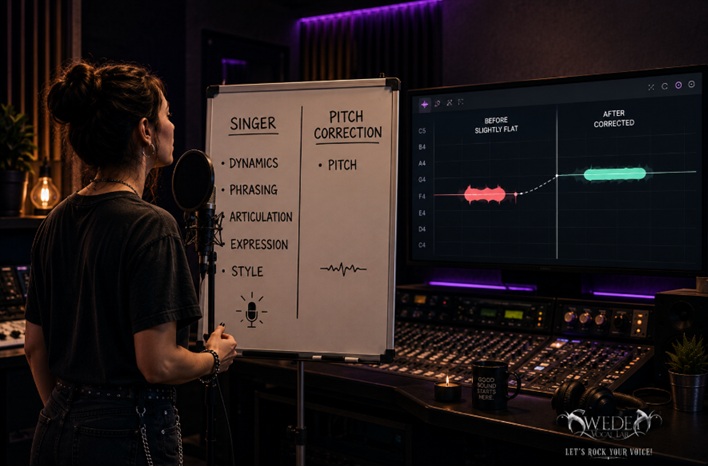
Pitch correction tools can be extremely useful. They can correct pitch, smooth small inaccuracies and even become part of the aesthetic itself, depending on the genre.
But pitch is only one aspect of vocal performance.
A plugin can adjust the note after you've sung it. It can't give you better vocal coordination, more range, greater control over dynamics, cleaner transitions, different vocal qualities or the ability to reproduce a sound intentionally.
And that's an important distinction, because what you can do with your voice before processing determines what material you have to work with afterwards.
The More Control You Have, the More You Can Create
Modern production gives singers an enormous range of creative tools, and vocal technique should expand those possibilities rather than compete with them.
If you want a very clean sound, a rougher edge, breathiness, more weight, a lighter coordination, a dramatic dynamic change or a completely different colour for one section of a song, the question is whether you can produce those choices deliberately and consistently.
Vocal control doesn't mean making everything clean, polished or technically perfect. It means having enough awareness and command of your instrument to choose what you want it to do.
The more control you have before processing, the more options you have afterwards.
That includes the option to process the voice heavily. Effects don't become less valid simply because you could sing without them. They become another creative choice rather than something you depend on to create possibilities your voice doesn't give you in the first place.
Style Still Requires Skill
There isn't one “correct” vocal aesthetic. Soul, hyperpop, metal, trap and acoustic pop can ask for completely different things from a voice, and production itself can be an essential part of that language.
But if the music calls for a particular vocal quality, phrasing, articulation, dynamic behaviour or type of distortion, knowing how to create those elements gives you much more freedom than relying on the production stage to manufacture them afterwards.
A technically skilled singer doesn't have to sound polished. Technique can give you the control to sound clean when you want to, rough when you want to, intimate, aggressive, light, heavy or deliberately imperfect when the music asks for it.
The point isn't to make your voice conform to one idea of “good singing”. It's to expand what your voice can offer your music.
If you'd like to explore the relationship between technology and the human voice further, you may also enjoy reading
Does a Human Voice Still Matter in a World of Vocal AI?
And What About Pitch?
If pitch accuracy is the problem, correcting the recording doesn't tell you why the pitch was inaccurate in the first place.
The cause may involve auditory awareness, vocal coordination, tension, breath management or several factors working together. Identifying what is actually happening allows you to work on the cause rather than simply correct its result afterwards.
Vocal training can make pitch accuracy something you can reproduce yourself, including when you're rehearsing, performing live or simply singing without any processing at all.
And once pitch stops requiring so much of your attention, you have more room to focus on everything else that makes a performance yours.
Two Different Parts of the Same Creative Process
Pitch correction can shape the recorded result.
Vocal training expands what you can do before the recording is ever processed.
There is no reason to choose between the two. Production can transform, enhance or deliberately manipulate a voice, while vocal training gives that production more to work with in the first place.
The more your voice can do at source, the more freedom you have to decide what the final result should sound like.
Svenska
När det finns Autotune, varför ta sånglektioner?
Vokal färdighet och dess roll i modern musikproduktion.
Vad korrigerar Autotune egentligen?
Verktyg för tonhöjdskorrigering kan vara mycket användbara. De kan korrigera tonhöjd, jämna ut mindre felaktigheter och till och med bli en del av själva estetiken, beroende på genre.
Men tonhöjd är bara en del av en vokal prestation.
Ett plugin kan justera tonen efter att du har sjungit den. Det kan inte ge dig bättre vokal koordination, större register, bättre kontroll över dynamik, renare övergångar, fler vokala kvaliteter eller förmågan att återskapa ett sound medvetet.
Och det är en viktig skillnad, eftersom det du kan göra med rösten innan bearbetningen avgör vilket material du har att arbeta med efteråt.
Ju mer kontroll du har, desto mer kan du skapa
Modern produktion ger sångare ett enormt utbud av kreativa verktyg, och vokal teknik bör utöka de möjligheterna, inte konkurrera med dem.
Om du vill ha ett väldigt rent sound, mer raspighet, luftighet, mer tyngd, en lättare koordination, en dramatisk dynamisk förändring eller en helt annan klang i en viss del av låten, är frågan om du kan skapa de valen medvetet och konsekvent.
Vokal kontroll betyder inte att allt ska låta rent, polerat eller tekniskt perfekt. Det betyder att du har tillräcklig medvetenhet och kontroll över ditt instrument för att kunna välja vad du vill att det ska göra.
Ju mer kontroll du har innan bearbetningen, desto fler möjligheter har du efteråt.
Det inkluderar också möjligheten att bearbeta rösten kraftigt. Effekter blir inte mindre giltiga bara för att du skulle kunna sjunga utan dem. De blir ett kreativt val snarare än något du är beroende av för att skapa möjligheter som rösten inte ger dig från början.
Stil kräver fortfarande skicklighet
Det finns inte en enda “korrekt” vokal estetik. Soul, hyperpop, metal, trap och akustisk pop kan ställa helt olika krav på rösten, och produktionen i sig kan vara en viktig del av det språket.
Men om musiken kräver en viss vokal kvalitet, frasering, artikulation, dynamiskt beteende eller typ av distortion, ger det dig mycket större frihet att kunna skapa de elementen själv än att förlita dig på att produktionen ska tillverka dem i efterhand.
En tekniskt skicklig sångare behöver inte låta polerad. Teknik kan ge dig kontrollen att låta rent när du vill, rått när du vill, intimt, aggressivt, lätt, tungt eller medvetet ofullkomligt när musiken kräver det.
Poängen är inte att få din röst att passa en enda idé om “bra sång”. Poängen är att utöka vad din röst kan erbjuda din musik.
Om du vill utforska relationen mellan teknik och den mänskliga rösten vidare kanske du också vill läsa
Spelar den mänskliga rösten fortfarande någon roll i en värld av vokal AI?
Och hur är det med intonationen?
Om intonationen är problemet, berättar en korrigerad inspelning inte varför tonen var fel från början.
Orsaken kan handla om auditiv medvetenhet, vokal koordination, spänningar, andningshantering eller flera faktorer samtidigt. Genom att identifiera vad som faktiskt händer kan du arbeta med orsaken i stället för att bara korrigera resultatet i efterhand.
Vokal träning kan göra intonation till något du själv kan återskapa, även när du repeterar, uppträder live eller bara sjunger helt utan bearbetning.
Och när intonationen inte längre kräver så mycket av din uppmärksamhet, får du mer utrymme att fokusera på allt annat som gör framförandet till ditt.
Två olika delar av samma kreativa process
Tonhöjdskorrigering kan forma det inspelade resultatet.
Vokal träning utökar vad du kan göra innan inspelningen ens bearbetas.
Det finns ingen anledning att välja mellan de två. Produktion kan förändra, förstärka eller medvetet manipulera en röst, medan vokal träning ger produktionen mer att arbeta med från början.
Ju mer din röst kan göra redan vid källan, desto större frihet har du att bestämma hur slutresultatet ska låta.